10.01.2021
Ten years have passed since the first major competition in the Bratislava House of Sports (Slovak Grand Prix). In those ten years, an unknown sport in Slovakia has become one of the most successful. Since their first entry onto the international scene, our representatives have not returned home without a medal. We have managed to assert ourselves on both the sporting and organizational scenes. Through hard work, the organizers of the Senec Hand have managed to turn this competition into an event of pan-European importance. People began to publicly speak about the Senec Hand as a mini European Championship, and winning it was among the most valuable achievements.
We managed to bring a fresh breeze to the organization and management of competitions. We succeeded in the field of officialdom; Slovaks were in the governing structures of the EAF and WAF, thus putting their stamp on the direction of world armwrestling. We managed to achieve a lot in ten years.
In 2003, for the first time, we witnessed a decrease in regional competitions. After years of enthusiasm, "organizer fatigue" set in. Many of our traditional collaborators realized how difficult it is to organize an event year after year. In light of these facts, we appreciated those who managed it all the more.
The SNLP again had 4 rounds, but for the first time, the last one was the Senec Hand. This reduced the number of "first" league events from five to four. Besides Senec, the individual rounds were hosted by Bratislava, Banská Štiavnica, and Revúca.
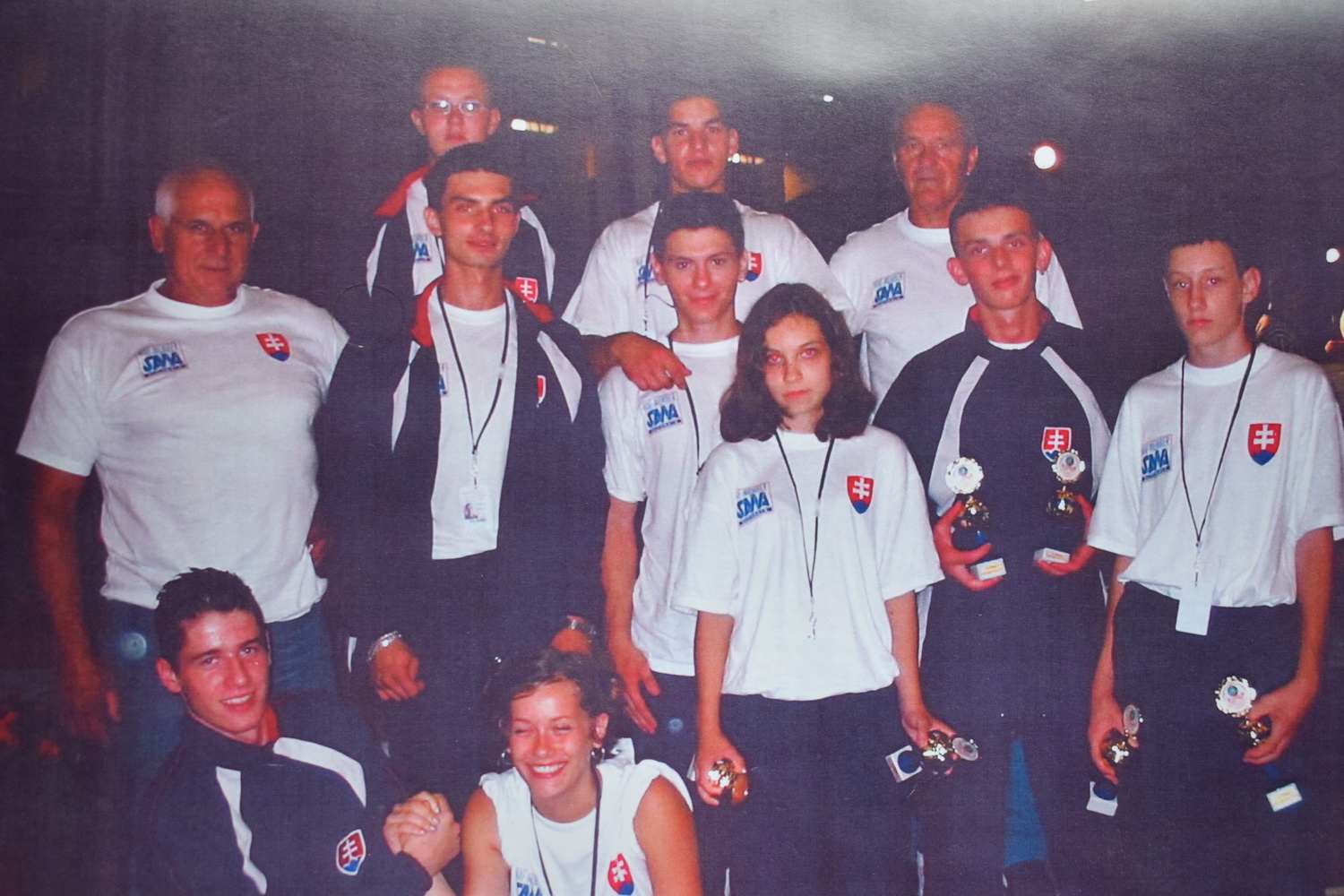
The Slovak Junior Championships were traditionally held in Ivanka pri Dunaji. The event, which grew in quality from year to year, provided us with much joy and hope before the European and World Championships in 2003.
The adults met for the national championship in Žarnovica with the participation of almost the entire Slovak elite. A great level, exciting matches, and winning favorites—that is how the Slovak Championships could be briefly evaluated.
Of the regional competitions, only the Iron Hand, Papradno 2003, New Year's Eve Hand, and the Strong Hand of High Schoolers took place. At the Strong Hand, for the first time, athletes competed for the BSK Chairman's Traveling Cup for absolute winners, which only increased the prestige of this competition. The first winners of the cup were P. Chladný and P. Fričová.
The organization of regional championships was abandoned, as they were becoming harder to realize year by year and did not bring the effect we had expected from them.
The Senec Hand again had a great level, mainly thanks to the Slovak representatives. In Senec, we introduced an innovation in competition management - monitors for referees. We placed a monitor at each table showing the match participants. This made it easier for referees to check if the right people were standing at the table and sped up the course of the competition.
The European Championships for both juniors and seniors were held in Hanau, Germany. After the first joint EAF championship in 2002 in the Czech Republic, this was the championship confirming unification. The organizational part of the championship was handled by a Slovak team under my leadership. Together with the German federation, we wanted these European Championships to be the highest quality organizationally in history. Before the EC, we conducted an inspection trip to Hanau to fine-tune all the details on-site. A record number of competitors participated in the championship; we recorded a record number of competitors in a single category (33), for the first time the competition was held on more than two tables (4), and for the first time in history, monitors were available for referees, which we had successfully tested at the Senec Hand. A WAF commission was also present at the EC to evaluate the quality of our software. In the end, the inspection turned into espionage, because months later the Canadians introduced their own software, which, however, did not come close to ours in quality.
The successes of previous years and high-quality domestic competitions whetted our appetite, and we expected great results from our representatives' performances. These did arrive, although in several cases that proverbial small step to the highest goals was missing.
At the EJCH, we won four silver (K. Tóthová, Ľ. Jagnešák, T. Tóth 2x) and three bronze medals (K. Tóthová, S. Mihoková, Ľ. Jagnešák). Despite the fact that our youth did not win gold, they confirmed that they belong to the world elite.
Among the seniors, the biggest surprise was provided by R. Tomaga, who won gold for the first time, expanding the number of Slovak European champions. The medal collection was completed by J. Germánus (silver) and R. Dobrovič (bronze). After four gold medals (EC and WC in 2002), this was a step back for Germánus, but it must be said that the main cause was a right shoulder injury, which did not allow him to give a 100% performance. This injury was not the last one to befall our most successful armwrestler that year. Since he was constantly flirting with the bench press and had a world record in mind, he was overcoming higher and higher weights during training. One day, during an attempt with an incredible 260 kg on the bar, his chest muscle gave out. Although the serious injury interrupted our successful representative's career for a certain time, it did not end it.
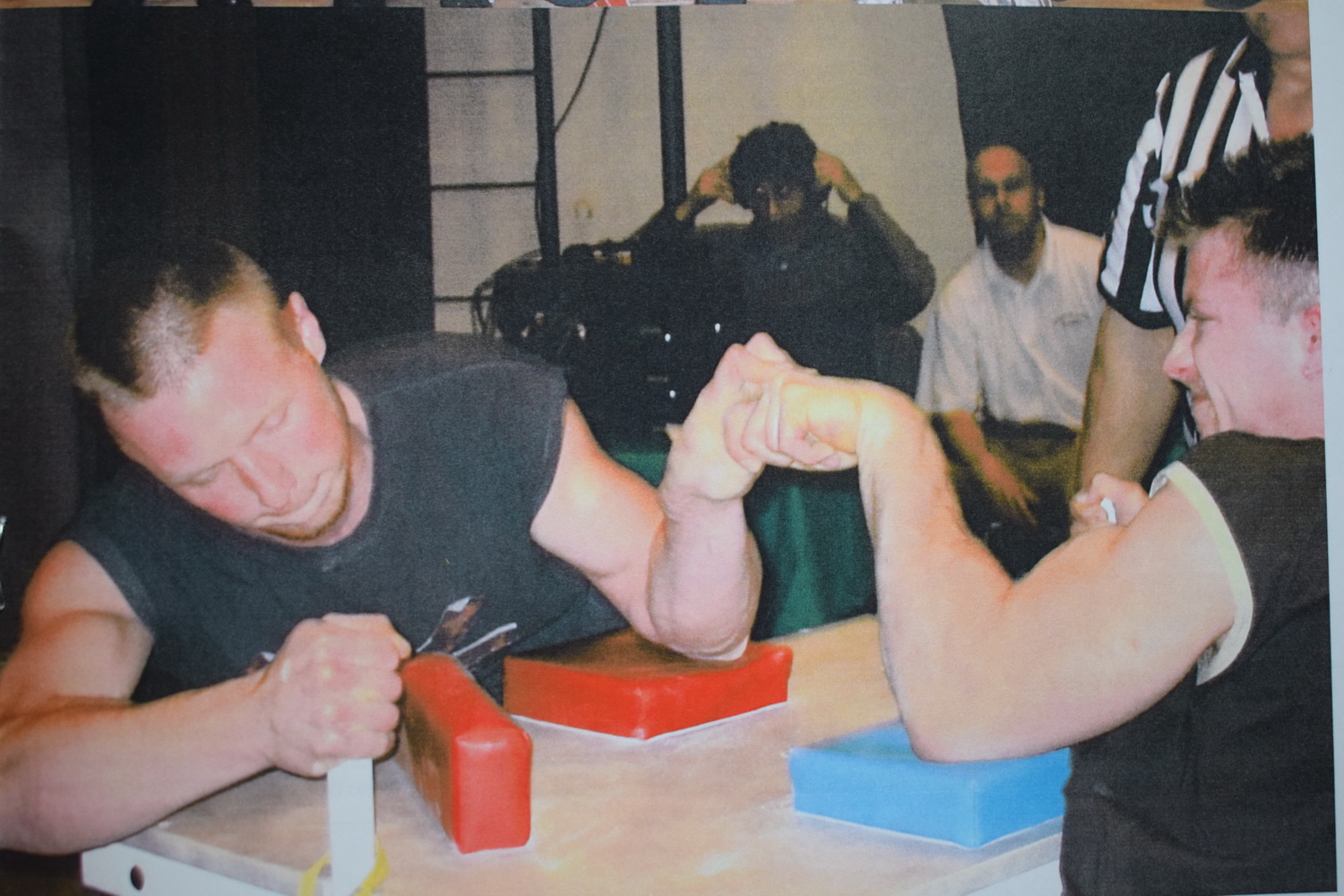
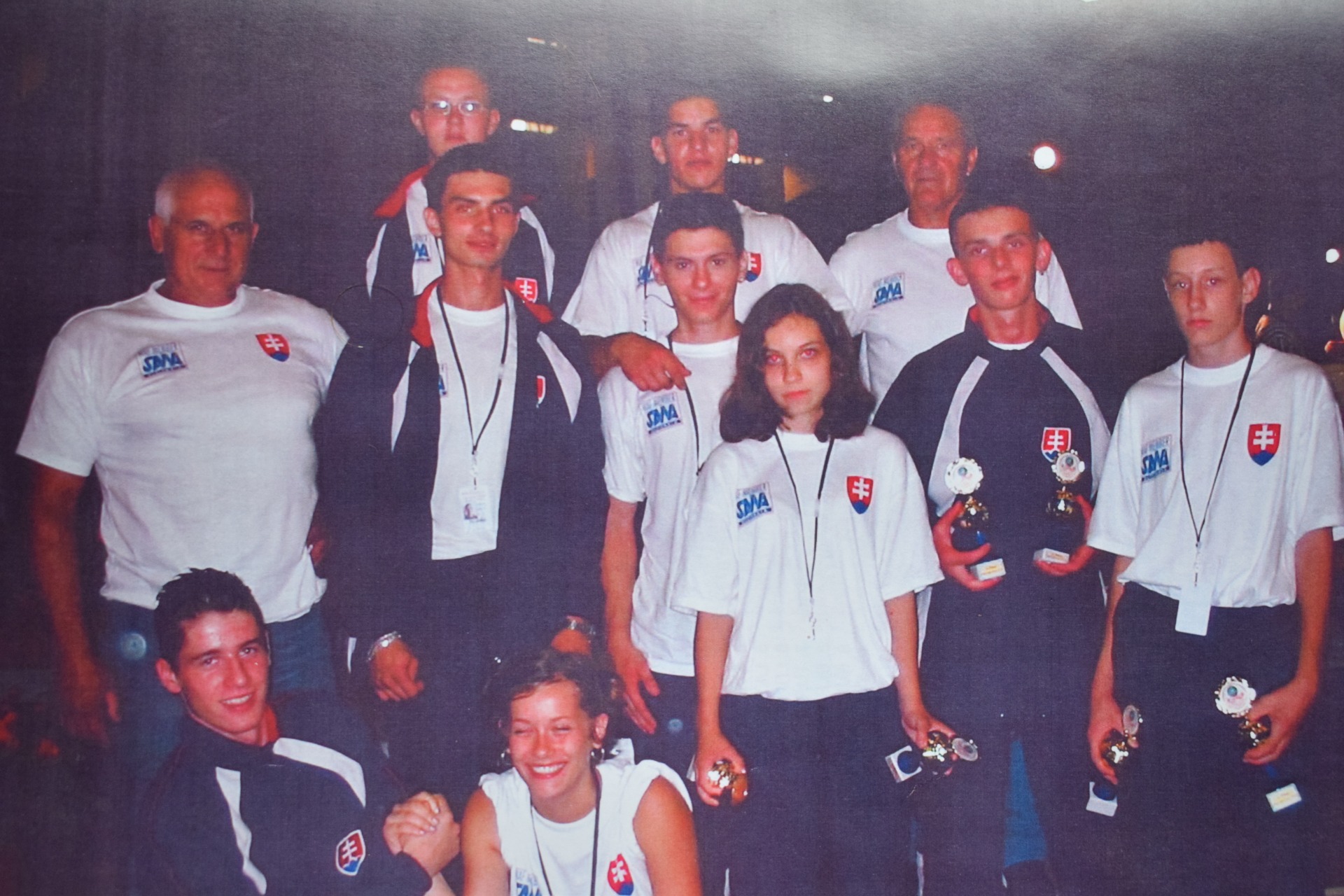
The World Junior Championships were held separately for the last time, in Gdynia, Poland. After a successful EJCH, we sent a strong team to the Baltic Sea, which again did not disappoint. Four silver (Ľ. Jagnešák 2x, K. Tóthová, T. Tóth) and one bronze (T. Tóth) medal were an excellent result in the great competition of 13 teams. Both Jagnešák and Tóthová were very close to gold, and Katka even had a cry after the final.
After my trip to Springfield (USA) last year, negotiations on the unification of WAF intensified. The result was an agreement on a joint World Championship. The venue was Ottawa, Canada. Originally, we thought that details of the unification would be discussed at the WC, but the opposite was true. The unification of WAF meant a return to the past for armwrestling. All the changes we had prepared and successfully put into practice (automation of competition management, new weight categories,...) were swept off the table. Why? Simple. First - WAF is managed by an executive committee consisting of the presidents of continental federations, meaning it is not elected. For some of them, it is important to have a position, and their "work" ends there. Second - many European countries were missing at the WC in Ottawa, so even if there was a vote, "our group" had no chance of outvoting anything. Furthermore, the unification brought to the forefront the future president of the EAF and WAF, the Bulgarian Hadjitodorov, about whose activities we will write much more.
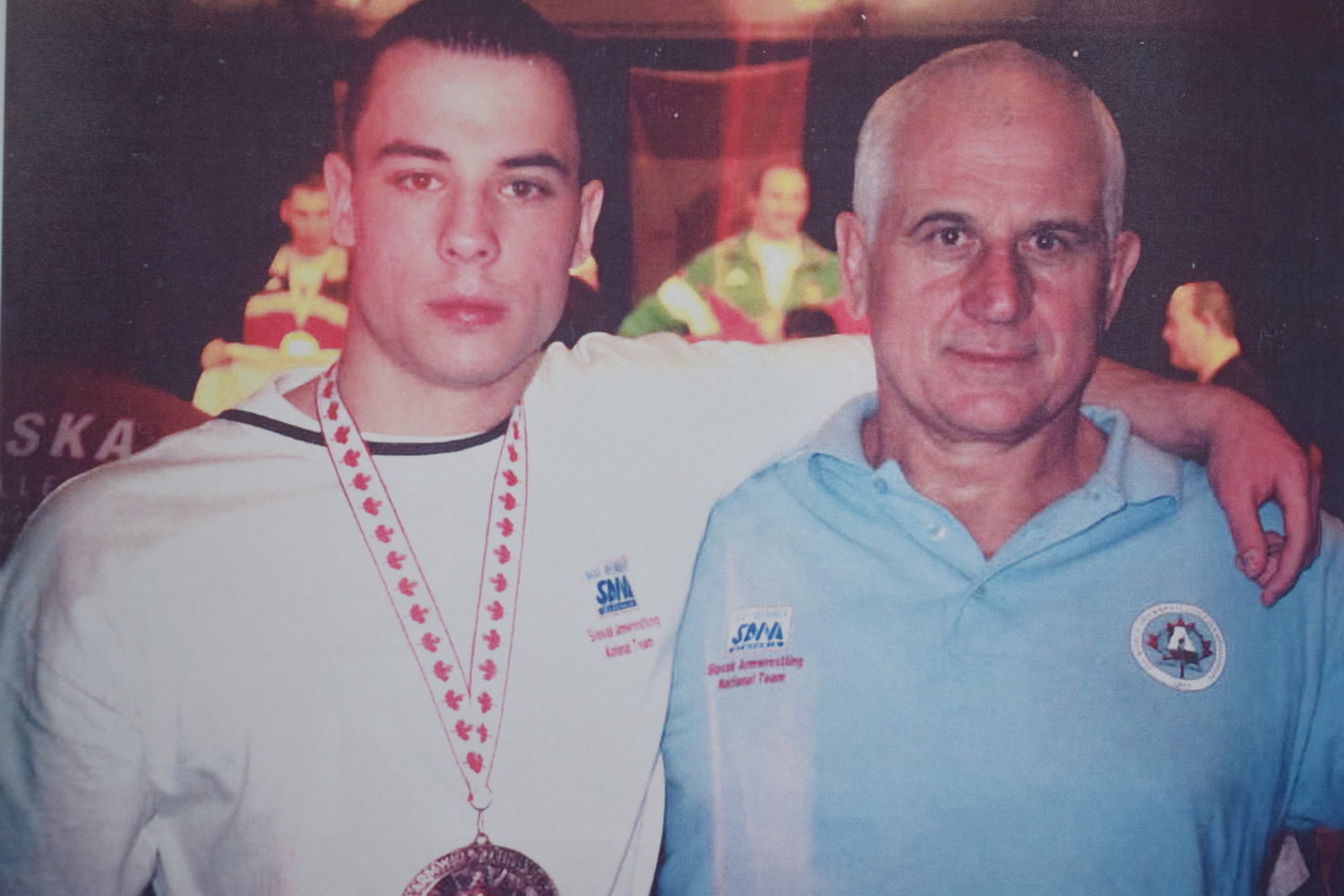
Due to financial demands and the health problems of some of our representatives, only a small delegation traveled from Slovakia to Canada. European Champion R. Tomaga, R. Dobrovič, and the newcomer M. Ďalák were the trio that was to fight for another precious metal for our homeland. We placed the greatest hopes in Tomaga, but he felt firsthand what it is like when a competition is managed on slips of paper. The referees suddenly interrupted his long-lasting match for advancement to the final four against I. Mazurenko (POL) and ended it prematurely due to an "error" in the bracket. They assigned different opponents to both, and of course both, already tired from the previous battle, lost their matches. This case was not unique with this type of competition management, and that is why we had switched to automated competition management years ago.
Dobrovič did not have the best form in Canada, so the colors of Slovakia were saved by the youngest member of the delegation, M. Ďalák. And successfully. However, his medal also hung by a thread, or rather, on the decision of his opponent. The organizers had prepared another surprise for our delegation when they did not follow their own time schedule and started the final matches 15 minutes earlier than planned. Only the fair-play attitude of Ďalák's opponent, who was none other than our long-time acquaintance, the Swiss P. Girard, meant that the match took place. Pascal did not accept being declared the winner, sat on the podium and waited until his opponent (Ďalák) arrived in the hall. And then he lost fairly in the match, giving us double joy. Firstly, that fair athletes have not yet died out, and secondly, from winning the only medal for Slovakia.
To honor this act of fair play, we awarded P. Girard a commemorative prize and presented it to him during his participation in the Senec Hand.
Thus, 2003 was again a successful year for Slovak armwrestling. From the perspective of time, however, I also evaluate it as the year in which the great family of armwrestlers began to split. Politicking, animosity, and behind-the-scenes battles were added to the sport. The joy of meeting friends was replaced by tension. And that was only the beginning.