08.11.2020
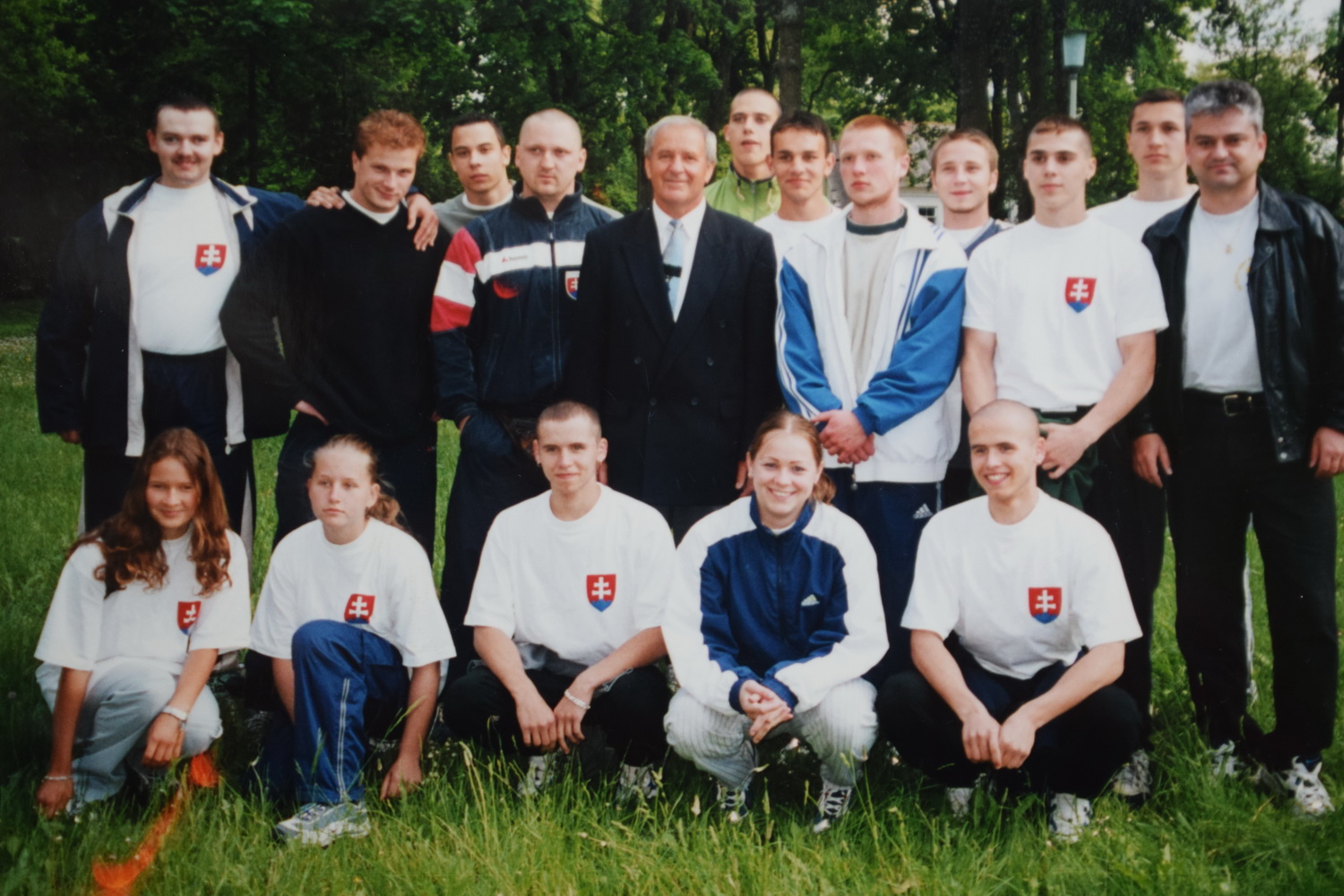
Traditionally, we devoted great effort to organizing domestic competitions. The top SNLP competition had four rounds (Trnava, Banská Štiavnica, Revúca, Bernolákovo), the Slovak Championships were held in Bardejov, and the Junior Slovak Championships in Ivanka pri Dunaji. In addition, we again organized or helped organize a number of regional competitions - regional championships, the Strong Hand of High School Students, Iron Hand, Brezová Hand, Gemer-Malohont Hand, and the Šariš Armwrestling Grand Prix.
The number of competitions also meant many new faces and new talents. New names began to appear at the top of the results lists. When I leafed through my memories, it was specifically in 2001 that both the Junior Slovak Championships and the Senior World Championships were full of surprises. Among the seniors, the biggest surprise was provided by J. Vavrek, who defeated the experienced R. Dobrovič in the left-hand final despite entering the final with one loss. In the right hand, the rising generation already reigned in most categories (M. Ďalák, P. Mišovič, R. Dobranský, S. Hlubik). Of the "senior" members, only the old veterans R. Dobrovič and J. Germánus were able to keep pace with them.
In the junior category, we witnessed a paradoxical situation. Increasing competition meant that they had to earn their nomination for the European Junior Championships in a special qualification. This had never happened before.
Senec Hand saw a drop in international participation. A scheduling conflict with the European Championships caused the organizers to decide for good to move the competition from a summer to a spring date. This change only took effect in 2002, when Senec Hand was included in the SNLP scoring for the first time.
From the international calendar, we chose the traditional competition in Czechia - Golem's Hand and the Muscle Mania competition in neighboring Austria. At Golem's Hand, our athletes won 7 first, 3 second, and 1 third place. In Austria, 3 first, 3 second, and 4 third places. For the second time, our representatives appeared at the prestigious Zloty Tur tournament in Poland. The trio of Petrová, Germánus, and Ivančo won two first and two third places. The highlight of the tournament was Germánus, who won his category and later the battle for the absolute winner. In the absolute final, he met A. Voevoda (RUS), who, after a difficult qualification, was no longer a match for Germánus.
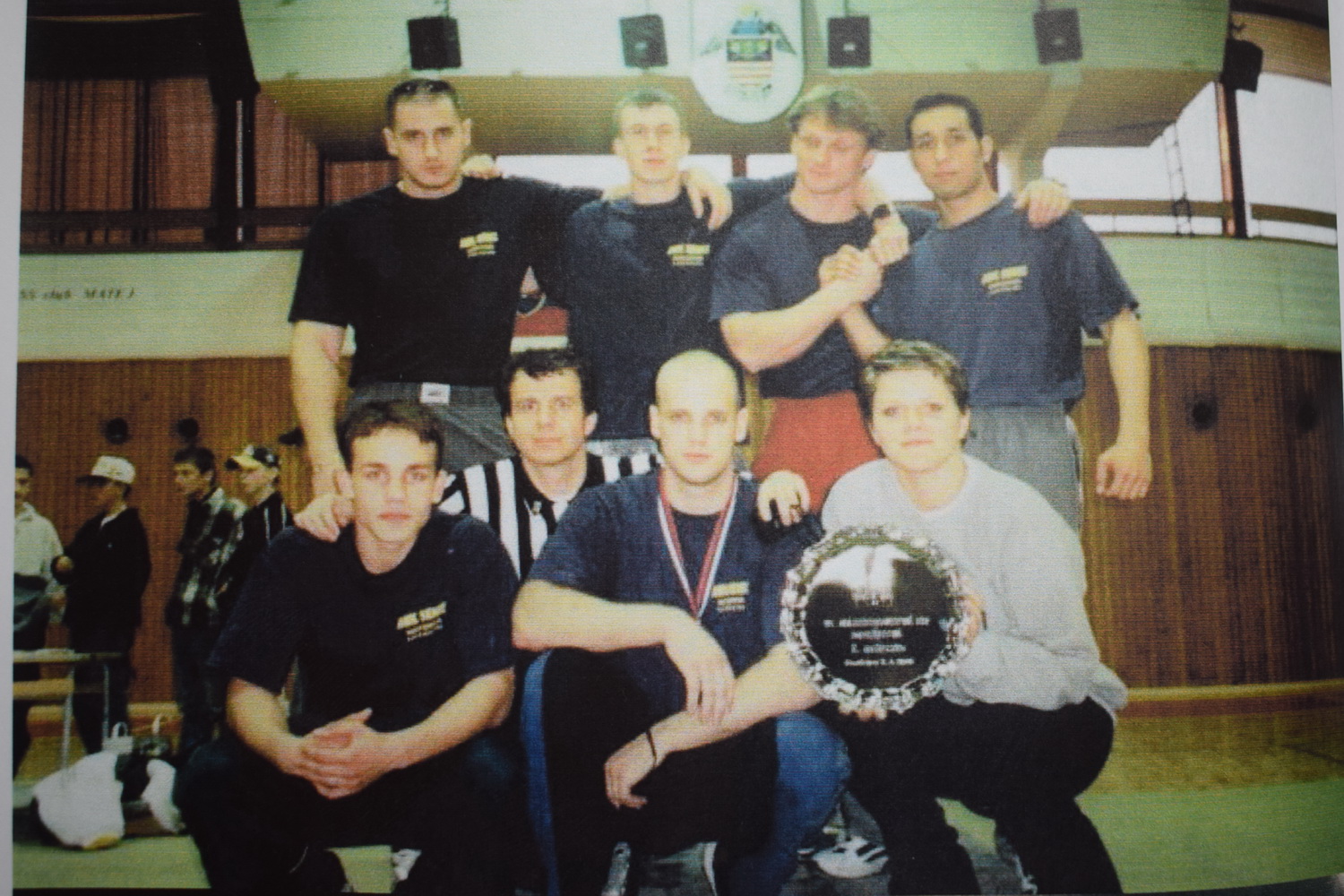
The European Championships for both juniors and seniors were held in Druskininkai, Lithuania. This was already our second visit to this beautiful spa town (the first one, endless and unforgettable, through Belarus in 1998). At the European Championships, our computer program for managing the competition was used for the first time. We finally got rid of "papers" not only in Slovakia but also in Europe. We also recorded a significant success in the election of the new EAF Executive Committee. The author of this article was elected as a member of the EC ( J ). It was another recognition of our work.
The juniors had it tough at the tables. Extremely strong competition gathered in Lithuania. Of our athletes, only K. Sherhauferová and S. Hlubik stood on the winner's podium. Both won two bronze medals each. In the senior categories, we were more successful. Again, we fought for gold. This time, however, Slovaks stood on both sides of the table - P. Gazdarica and J. Germánus. Both met already in the qualification, and to the surprise of the whole hall, Peter emerged victorious from this match. In the final, Germánus tried to pull the victory to his side. He won the first final, but in the rematch, he was no longer a match for his opponent. The gold medal was deservedly hung around the neck of the happy Gazdarica (in addition to gold, he also won bronze in the left hand). Germánus did not go home without gold, however; he won in the left hand.
The World Championships were also held separately in 2001. Originally, the Junior Championship was to be held in Italy and the Senior one in Brazil. However, when Brazil withdrew from organizing the World Championships, the Italians seized the opportunity and decided to organize them. For the same reason, however, they resigned from organizing the Junior World Championships, which were already beyond their capabilities. In the organizational vacuum, the diplomatic skills of WAF President M. Čapla became apparent; after negotiations, he finally convinced the Hungarian federation to organize the Junior World Championships. Even here, the organization was not without problems, and the date of the Slovak Championships was moved several times. In the end, however, the championship was organized in Hungary, and for us, it was an extremely successful Junior World Championship. We won one gold, two silver, and four bronze medals there.
From the hospital to gold—this could also be the headline of the report from the Junior World Championships. And indeed it was. Everyone who competes in a sport where you "chase" weight knows what it's about. About deprivation, fasting, dehydration. M. Ďalák found out what this does to an athlete in Hungary. After fasting and weighing in, he collapsed and ended up in the Kaposvár hospital on an IV drip. It seemed that the competition was over for him. To our pleasant surprise, he appeared in the hall the next day. He did not look tired or exhausted at all. He gave a great performance at the table and won a bronze medal. The right hand was even more successful in his case, and he won a surprising gold. On the podium, he was joined by S. Hlubik with two silvers and D. Rummelová, R. Dobranský, and R. Málek with bronze medals.
The organization of the Senior World Championship was also not without problems. Although the WAF president's diplomacy was successful after Brazil's withdrawal, further complications arose in September. The terrorist attack in the USA threatened the organization of the World Championships. Again (as in 1999), WAF President M. Čapla stood up for the organization and convinced other members of the EC to support the World Championships and not vote for their cancellation. The president's activity was successful, and it must be said that the participation was great and the championship ranked among the highest quality World Championships in history.
Before the World Championships, discussions took place behind the scenes about which system would be used for the event. Whether the American paper system or our computer system. The experience from the European Championships in Lithuania spoke in our favor. It wasn't enough. The only concession was the opportunity to show our system during the masters and disabled categories. It was a small consolation, but at least an opportunity to show that a competition doesn't have to end at three in the morning.
Our athletes won four medals. Germánus shone, winning the gold double for the third time in a row. Gazdarica won silver and was indeed not far from gold. He even won once in the final, and the Russian Chochayev only deprived him of the title in the rematch final. A surprise was the bronze medal of the "little guy" among the giants, R. Tomaga. He competed in the heaviest category and dealt with such "giants" as the Hungarian C. Szabó or the Czech F. Živný.
The "great" calling of competitors by numbers deprived us of another medal. When calling the competitors, they mixed up the numbers for our R. Dobrovič and T. Kiss and only called one of them.
Even this negative experience did not change the fact that 2001 was also an extremely successful year for Slovak armwrestling.