28.01.2021
The domestic scene did not see dramatic changes. We organized four rounds of the SNLP in mostly traditional locations - Vavrečka, Senec, Banská Štiavnica, and Revúca. Participation was pleasing; although it did not reach the level of over a hundred competitors from the previous year, it still maintained encouraging numbers. Germánus missed the first part of the season as he was still struggling with an injury and only appeared at a competition for the first time in the autumn.
The Senec Hand recorded another first - for the first time in history, our armwrestlers did not win in a single category. Victories were shared by the national teams of Ukraine (9), Bulgaria (2), and Italy (1). High-quality international participation, full categories (there were 32 competitors in the 70kg class and even 34 in the 86kg class), and great organization caused our competition to be referred to as the mini European Championships.
The Slovak Championships were held in Bardejov. They went down in history due to the presence of doping control officers, who tested the Slovak champions, making this championship the first (and for a long time the last) domestic competition where athletes were tested for the use of banned substances. Among the winners, we surprisingly found P. Racek, who won the title in the heaviest category, leaving behind giants such as P. Spusta and J. Michalička.
The Junior Championship pleased with high participation, as up to 24 armwrestlers competed in the under 70 kg category. Our work with juniors confirmed that we do not have to worry about the future of Slovak armwrestling. This was also shown by a look at the results list, where among the junior national champions, we could find names like L. Debnárová and Ľ. Jagnešák.
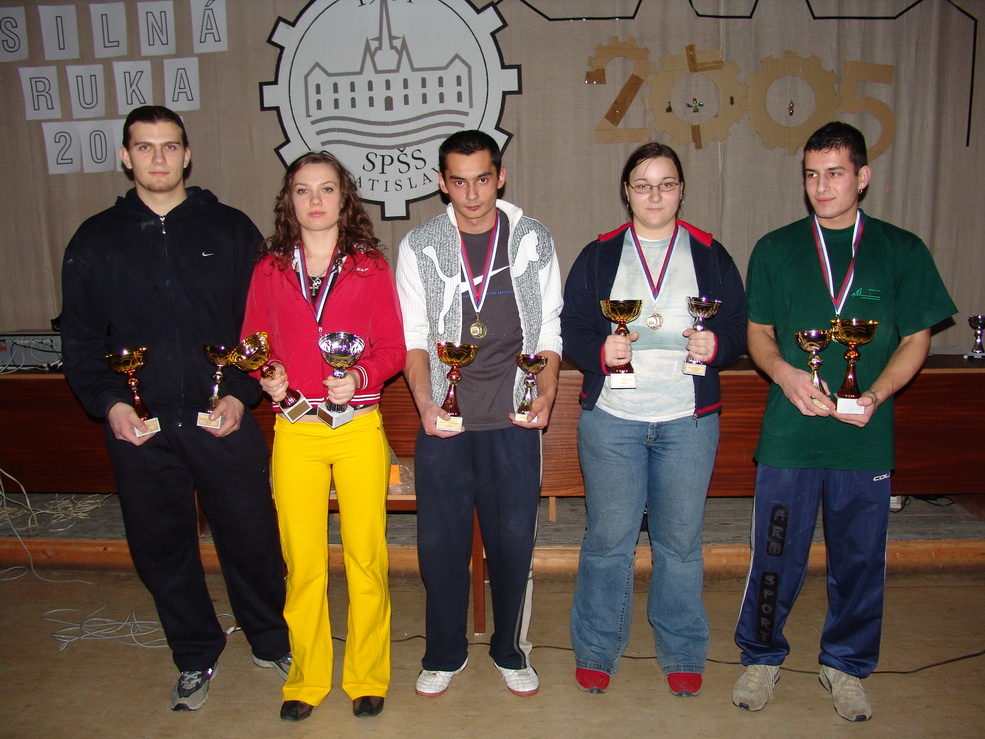
Traditional competitions like the Strong Hand of High Schoolers and the New Year's Eve Hand maintained an excellent level. Strong Hand expanded again, and for the first time, all high schools in Slovakia could participate. Medalists from school rounds met in the regional finals - West (Bratislava), Central (Revúca), East (Bardejov) - so that the best of them could then meet at the national final in Bratislava.
At the New Year's Eve Hand, we again recorded a large turnout, which made it impossible to organize the competition in the traditional round-robin format, but rather in the classic double-elimination format.
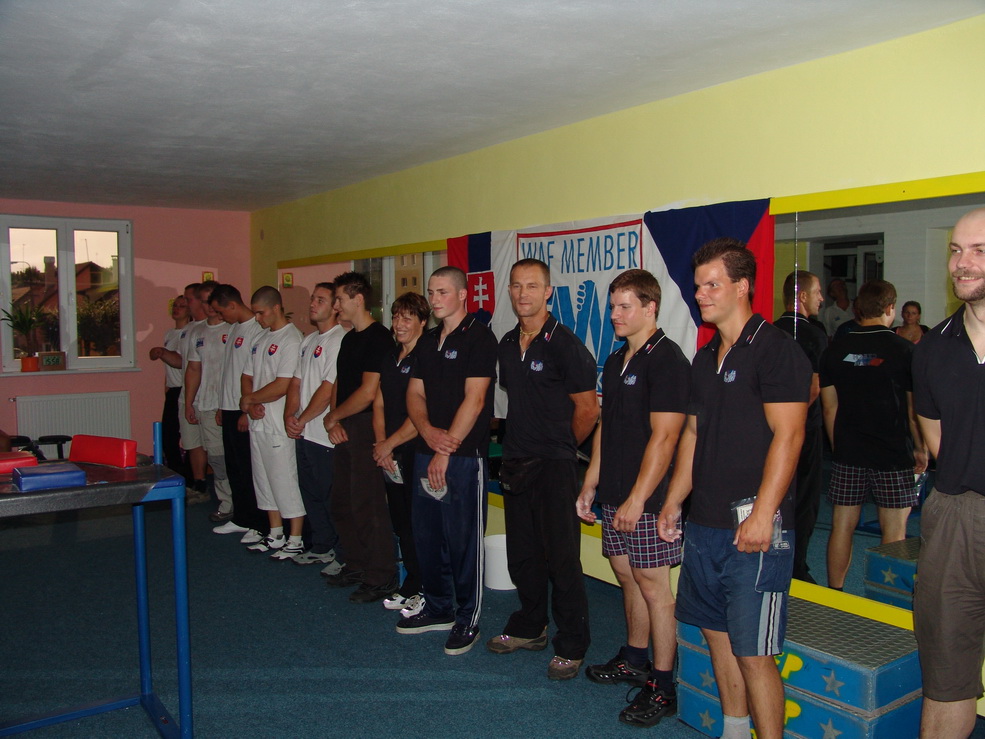
During the summer months, we planned four international trips - Belgium, Lithuania, Hungary, and Switzerland. However, we saw that after the initial hunger for international experience, the "sore hands" phenomenon prevailed, and only a minimum of our national representatives appeared at foreign tables. Not a single person even came to Belgium. The competition was technically supported by the Slovak team, for whom it was a great disappointment when, despite promises, not a single Slovak representative appeared at registration. We planned to send a junior team to Lithuania, but after initial enthusiasm, it ended similarly to Belgium. No one traveled to Lithuania. A dress rehearsal for the upcoming European Championships (2006) was held in Hungary. The competition was again technically supported by the Slovak team, and despite the proximity and low financial cost, only three representatives appeared at the tables - R. Dobrovič, P. Gazdarica, and P. Racek.
To Switzerland, where we again provided technical support, only one athlete traveled (S. Hlubik). Fortunately, his brother Matúš was active at the competition venue, so we had double representation at the event.
The only international competition where we had good representation in terms of numbers was the Golem Hand, which took place in Mikulov that year. In addition to the numbers, excellent results were a matter of course, which our athletes traditionally achieved at this competition (4-3-2).
In 2005, the World University Championships were to be held for the first time in history. This was the grand name given by the Russian federation to a competition for university students in Moscow. We liked this project very much and sent three athletes, university students, to the Russian capital - R. Dobrovič, R. Málek, and V. Mihoková. However, the competition in Russia was not what we expected. The organizer did not follow the WAF rule regarding the participation of two athletes per country in one category at all. Thus, for example, in the under 70 kg category, Russia was represented by 39 athletes. The competition used the Russian system, where points were earned for results in each hand, and the competitor with the highest number of points from both hands won the category. Our athletes did not get lost even in such strong Russian competition and took respectable 4th (Málek) and 6th (Dobrovič) places. This attempt at a University World Championship remained a one-off and has not been repeated to this day.
The European Championships visited Sofia, the city below Vitosha. Organizationally, they were preceded by my inspection trip, where we fine-tuned all technical details of the championship during the Bulgarian Championships. More innovations awaited us. For the first time, the competition was held over four days. Juniors, masters, and disabled athletes competed for the first two days. Seniors for the next two days. Registration and weighing had to be adapted to this to ensure rules were followed. For the first time in history, weigh-ins were held twice - separately for the first group of athletes competing the first two days, and separately for the second group of athletes. This placed great emphasis on logistics, technical, and organizational support for the event. We are glad that our team handled it perfectly, and during the European Championships, we did not record any delays or hitches in the organization. Another innovation was doping control, which was held in armwrestling at such a significant event (EC, WC) for the first time.
The Slovak delegation traveled to Bulgaria missing some well-known names. For health reasons, J. Germánus and R. Tomaga could not participate in the championship, while P. Gazdarica and B. Zajvald were absent due to work commitments. Nevertheless, we believed in success and medal placements.
The juniors confirmed their place among the European elite and won three gold (Ľ. Jagnešák 2x, M. Maťaš), two silver (L. Debnárová, M. Maťaš), and one bronze (L. Debnárová) medal. They underlined this great success with a third-place team finish, leaving behind even the strong Ukrainian national team.
The senior part of the national team won three medals thanks to P. Spusta (silver), R. Dobrovič, and Ľ. Jagnešák (bronze).
In 2005, the World Championships were again in an exotic location, in Japan. The competitions were preceded by the WAF Congress, where we again achieved diplomatic success with the election of MUDr. M. Babiak as a member of the WAF Anti-Doping Committee.
The juniors confirmed their place among the world elite. L. Debnárová appeared at the World Junior Championships for the first time and immediately won two gold medals. She was seconded by the boys - Ľ. Jagnešák winning two silvers and M. Maťaš winning a silver and a bronze medal.
The senior part, still thinned out by injuries and work commitments, recorded three bronze medals. Two were earned by the still-junior Ľ. Jagnešák, and the third was won by the returning P. Gazdarica. As the coach of the Slovak national team, J. Ďalák, correctly evaluated the performance at the World Championships in Tokyo: "We were a small delegation in numbers, but unmissable in results."