01.05.2020
Before I write about our activities in this year (1997), I would like to mention one fact that occurred at the end of 1996 and became a nice tradition persisting (with a small break) until today. At the end of the year, various New Year's Eve runs or other sporting events are traditionally organized. An idea for a similar event in armwrestling sparked in the head of our president. One thing led to another, we contacted clubs around Bratislava, and the Silvestrovská ruka (New Year's Eve Arm) was born. Although modest in its first year, over the following years, it earned a firm place in our annual calendar of events. The first winner and New Year's Eve champion was P. Klúčik.
In 1997, two fundamental changes occurred in the media coverage of armwrestling. First, I changed the format of the magazine Slovenský Armwrestling from a small bulletin (A5) to a classic format (A4) with a color cover and, in the second half of the year, a color double-page spread inside. No less important was the presentation of armwrestling on the emerging internet. After studying the basics of website creation, I published the first SAPR website, which complemented the magazine and provided up-to-date information from domestic and international events in our sport.
Our activities and goals in 1997 could be divided into two main groups: ensuring high-quality organization of the EC and succeeding in them. To fulfill the second goal, it was necessary to assemble a high-quality national team in the largest possible numbers. At the suggestion of the coaches, a wider selection of representatives was approved, with whom we worked intensively during the first half of the year. They were under close scrutiny at domestic competitions, and the best ones participated in international trips. It was important to bond the team, measure the performance of the nominees, and improve it through quality training. This was aided by two training camps organized in B. Štiavnica and Senec.
The Slovak Cup continued with four rounds (Bratislava, Trenčín, Liptovský Hrádok, Bernolákovo). The first two took place in the spring and served as suitable preparation for the Slovak Championships, which were one of the qualifying races for the EC. For this reason, the Slovak Championships had a high level and were not short on surprises. The biggest one was provided by M. Koczka, who in the premiere of the left-hand competition (in the first years we organized competitions only for the right hand; the left hand had its premiere specifically in 1997 at the Slovak Championships) won his category, leaving behind favorites R. Dobrovič and M. Petras. We organized the Slovak Championships in Poprad, and it was our organizational dress rehearsal for the September EC.
We organized the Junior National Championship in Bratislava. Its quality was significantly enhanced by the fact that it was a qualifying event for the European Junior Championships held in Great Britain.
The "Strong Arm of High Schoolers" also saw a change. For the first time, this now-traditional competition was organized at high schools throughout the entire Bratislava region (previously only at Bratislava high schools). Senecká ruka (Senec Arm) traditionally became the culmination of the domestic season, once again featuring high-quality national teams from Bulgaria, Czechia, Hungary, and Germany.
As I mentioned above, we emphasized increasing the international experience of our representatives. For the first time, we successfully participated in the prestigious Over the Top competition in Hanau, Germany. Among our athletes, P. Jarombek placed best at this competition, winning his category. P. Gazdarica also presented himself excellently, taking second place.
An exceptionally successful national team trip was the competition in Gorna Oryahovitsa (BUL). Our athletes recorded 3 first places (P. Gazdarica 2x, R. Dobrovič) and three second places (J. Durec 2x, R. Dobrovič).
Another event where our representatives reaped success was the Grand Prix of England. R. Dobrovič translated great form into a victory, and P. Jarombek complemented him among the men with a third-place finish. In addition, we gained two second places at this event (but I haven't managed to find out anywhere who won them, and my memory isn't that good).
In the same location, in the southern English town of Dymchurch, the second Junior EC took place. Slovakia sent a larger delegation with expectations of medal placements. And our athletes did not disappoint. In a high-quality competition, they won three gold, two silver, and two bronze medals. Great news was that in the nations' competition, we took an amazing second place. Our medals were earned by M. Pastuchová 2x, R. Dobrovič (gold), Ľ. Janíková 2x (silver), M. Banáš and P. Mišovič (bronze). With this result, Slovakia definitively confirmed that it is at the top of European armwrestling.
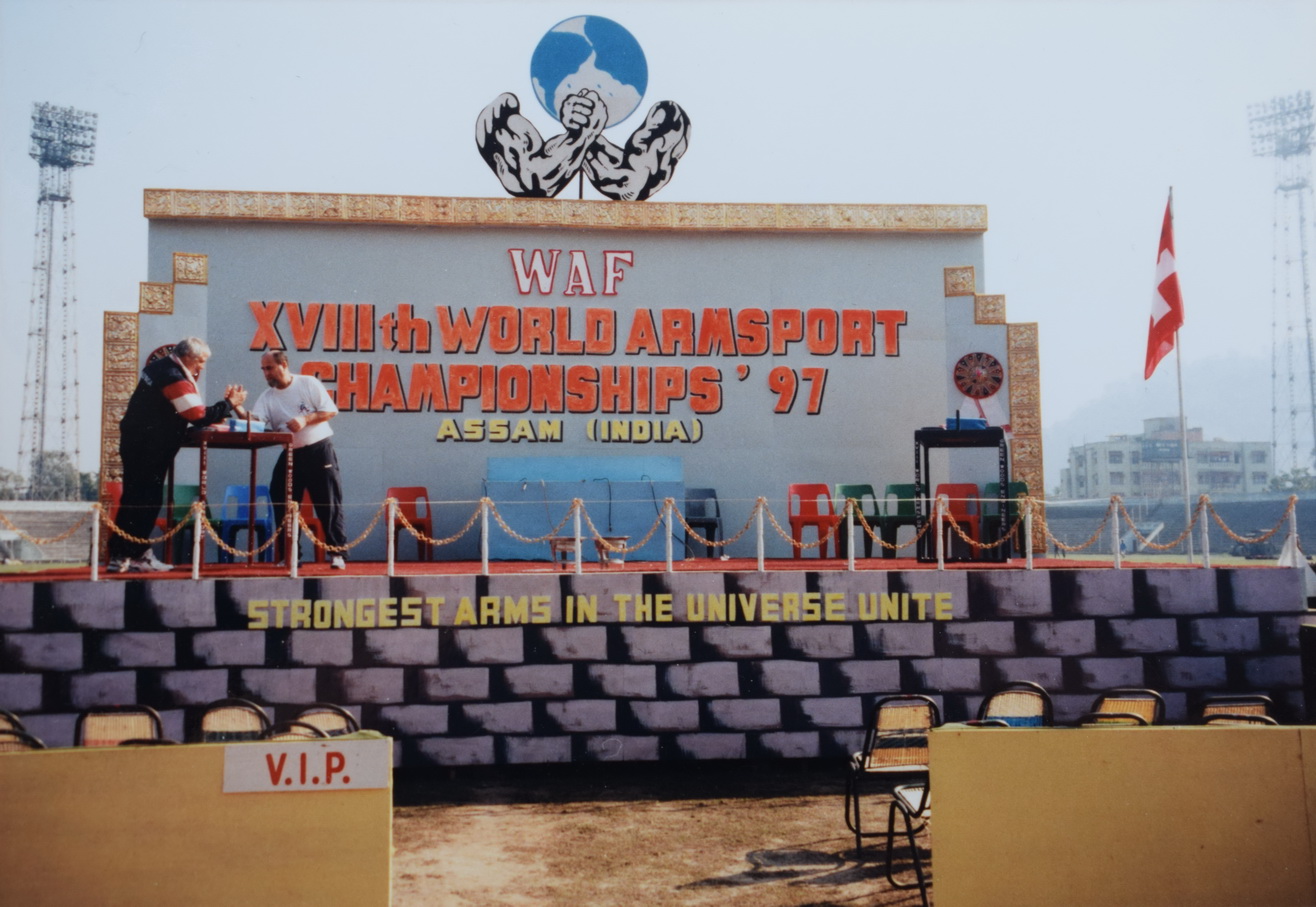
The 1997 World Championships were held in far-off India in the city of Guwahati, in the easternmost state of Assam. At that time, the situation in this part of India was quite tense, as Assam was striving for independence, which was felt mainly in the increased number of armed personnel in the city streets. Despite this, the championship proceeded in a peaceful atmosphere, except for accommodation problems (at the beginning, after a grueling journey of more than 24 hours, they drove us around the city looking for a vacant hotel). In the end, everything turned out well, and we could focus on the championship.
At the WAF congress, only one fundamental thing happened: we exported the junior competition from Europe to the world stage, and the congress approved the organization of the first Junior WC, which was to be held in 1998 in Moscow. Our president Milan Čapla was most responsible for its approval, as he submitted the proposal to organize the Junior WC and lobbied behind the scenes for its approval.
The WC matches were held under the open sky at the Nehru Stadium in front of a backdrop of 5,000 cheering spectators who created a great atmosphere. Slovakia was represented in the hot Indian sun by M. Pastuchová, R. Dobrovič, J. Durec, and J. Germánus. Despite the great efforts of our representatives, we did not win a gold medal, but after great performances at the tables, they fought for two silver medals. They were earned by M. Pastuchová and J. Germánus. In terms of quality, this championship was certainly the toughest, and the medals won confirmed that our path is the right one. We were already looking forward to 1998 and the WC, which was supposed to take us to Canada. But in the end, everything was different...