12.05.2020
In 1998, I changed the name of our internal magazine, and Slovak Armwrestling became Slovarm.
One fundamental change occurred on the domestic scene when regional competitions were transformed into Regional Championships. Smaller regional competitions suddenly became high-quality events that attracted even our best armwrestlers. A major motivation for participating in the Regional Championships was direct qualification for the Slovak National Championships.
The Slovak Cup again consisted of four rounds. The host cities in 1998 were Banská Štiavnica, Bratislava, Banská Štiavnica, and Košice. A very important moment was the inclusion of armwrestling in the program of the traditional Salamander Days in Banská Štiavnica. For the promotion of armwrestling, the final on the main stage at Trinity Square was the ideal location.
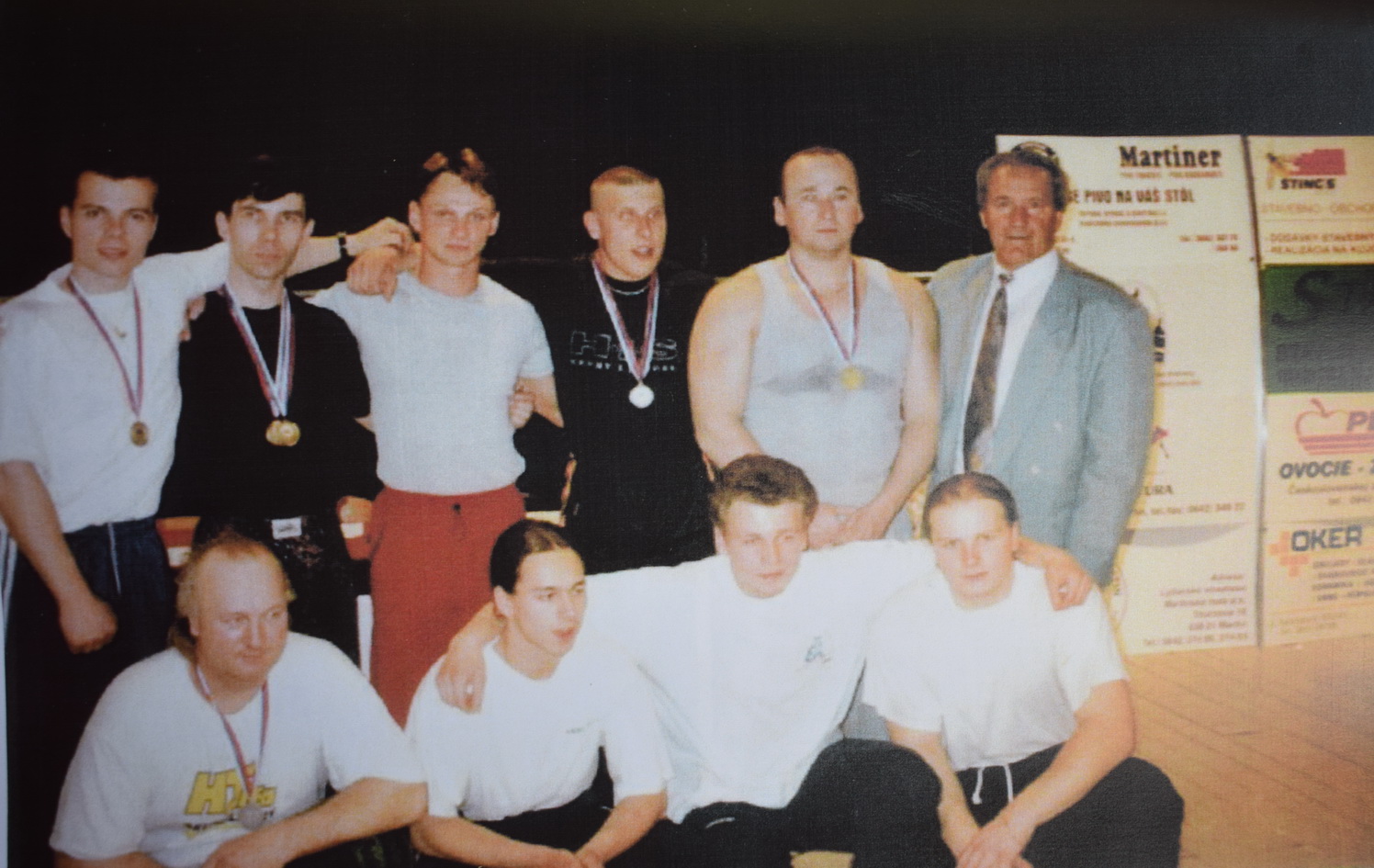
The Slovak National Championships were held in Martin, and the titles were taken by established favorites: P. Jarombek, R. Dobrovič, J. Germánus, I. Ivančo, P. Gazdarica, P. Mišovič, and A. Narančík. Among the women, I. Kopúňová and M. Pastuchová "reigned supreme."
In addition to the traditional events, we managed to organize more support events to promote armwrestling in the regions - Devínska ruka, Brezovská ruka, Gerulata, Junior Hand Vráble, New Year's Eve Hand.
Junior titles were also "claimed" by favorites P. Mišovič, R. Dobrovič, M. Mišík, and K. Veselá.
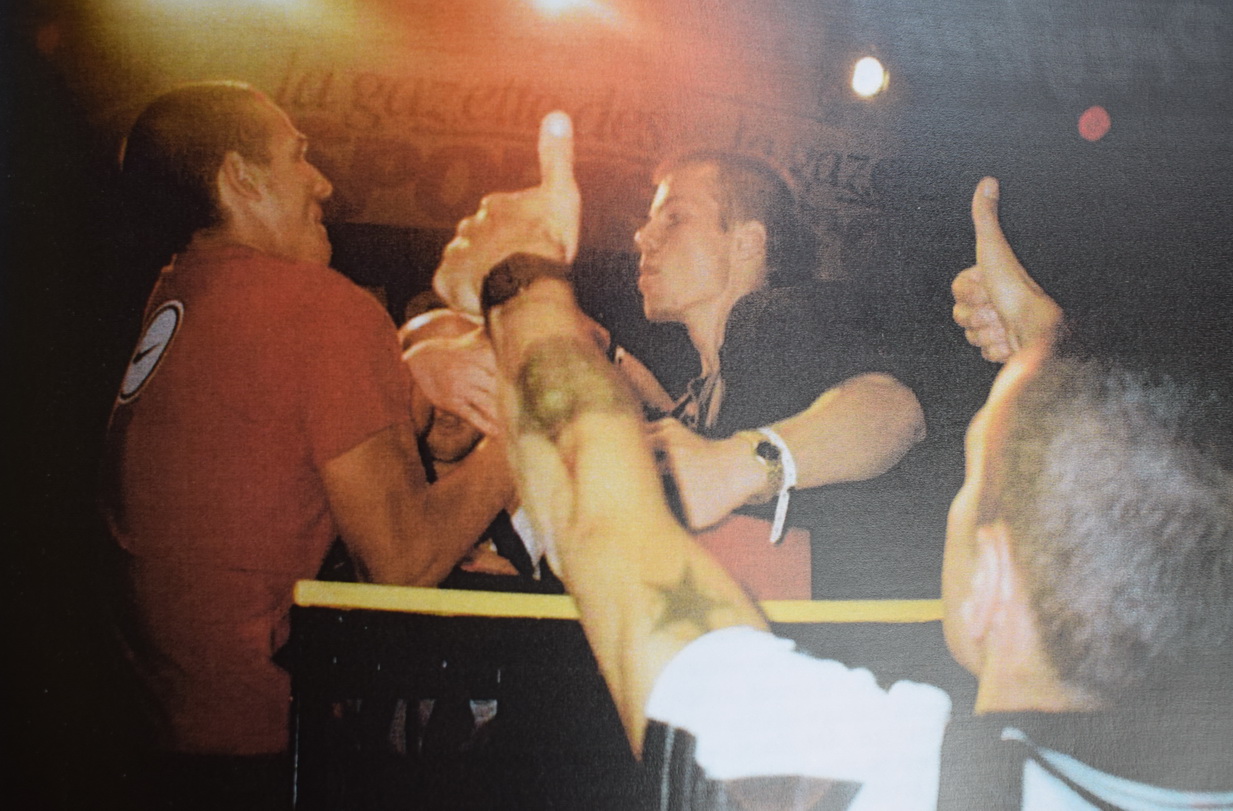
As I mentioned before, we placed great emphasis on gathering international experience. We once again visited Rochefort, Belgium, for the traditional Ready?Go! competition. Although we had a small delegation, it was all the more successful. P. Jarombek won in his category and D. Múčková took third place.
For the first time, we traveled to an international competition in Hungary for the 1st Armwrestling Gala Budapest. Slovakia was successfully represented by M. Pastuchová (2x 1st place), J. Germánus (1st place), T. Kiss (2nd place), D. Múčková (2nd place), J. Vavrek (2nd and 3rd place).
We sent a large delegation to Germany for the Over the Top competition. Our athletes were again among the best, and medal placements were earned by: P. Jarombek (1st place), J. Germánus (1st place), M. Pastuchová (2nd place), R. Dobrovič (2nd place), D. Múčková (3rd place), and M. Koczka (3rd place).
Once again, another edition of Senecká ruka held an irreplaceable spot, where, alongside competitors from traditional countries, a strong representation from Lithuania participated for the first time.
The juniors had their third European Championships in Prague. Our athletes took full advantage of the almost home-like environment and won three gold (2x K. Veselá, R. Dobrovič), one silver (M. Mišík), and two bronze (R. Dobrovič, P. Mišovič) medals. Furthermore, they took third place in the nations' competition.
For the first time, the Junior World Championships were held in 1998. Slovakia was represented by a trio of armwrestlers: R. Dobrovič, P. Mišovič, and M. Mišík. Despite their great efforts, they did not manage to win a medal. This was also due to an unusual decision by the organizer, who allowed the host country to enter up to three representatives in each category. Given the quality of the Russian team, one can imagine what the rankings in individual categories looked like. The Russians organized the Junior Worlds magnificently, and the final took place in the center of Moscow at Theater Square in front of a crowd of nearly 3,000 spectators.
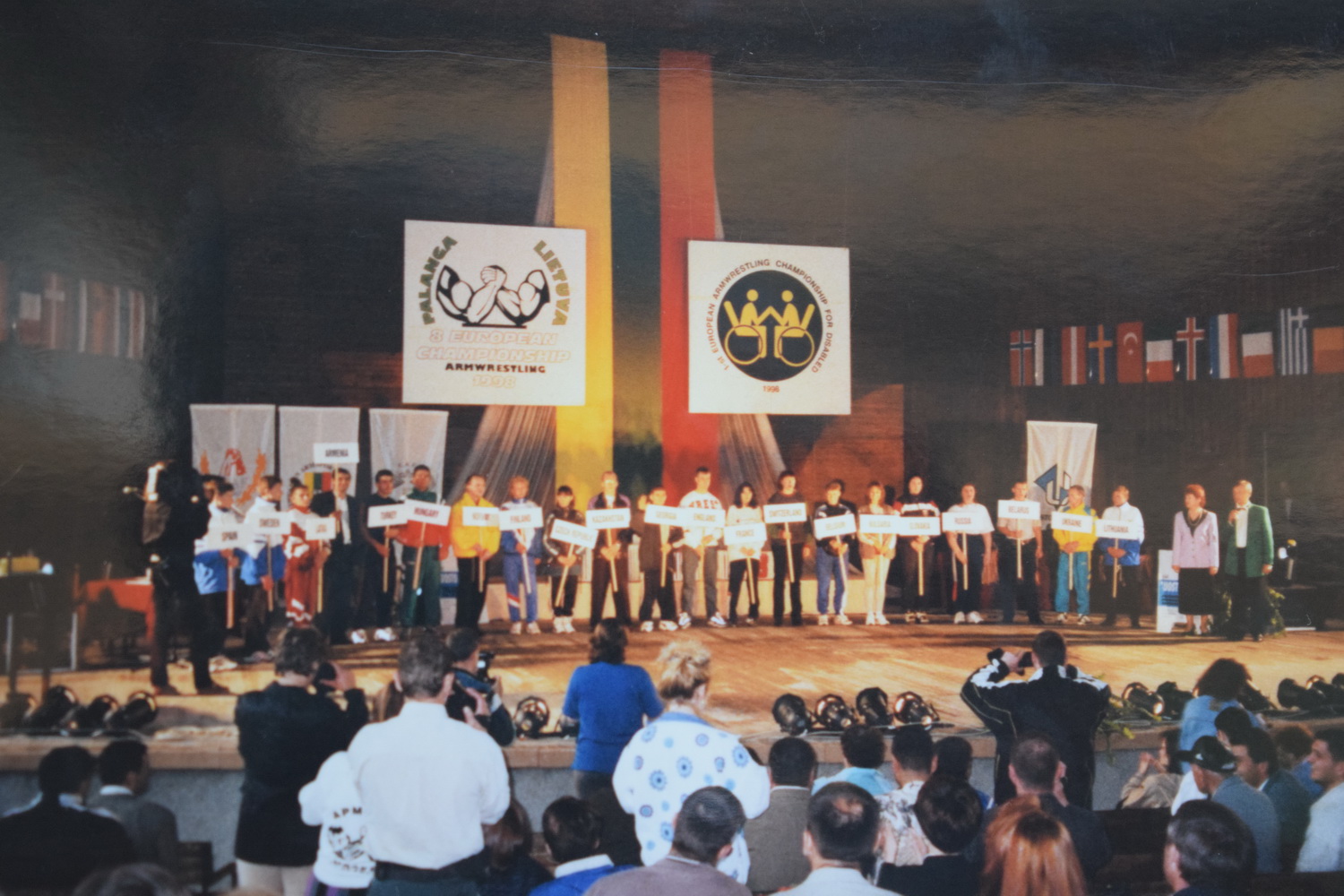
The European Championships were held in the Lithuanian seaside resort of Klaipeda. We took a large delegation to Lithuania and rightfully expected medals. But before our pullers even stepped up to the tables, interesting behind-the-scenes games began to unfold. Since the beginning of the year, a "battle" had been ongoing between the World Championships organizer (F. Roy, Canada) and the WAF General Secretary (B.B. Das, India). Both sides were exchanging threatening letters and notes, and tensions were high behind the scenes of the European Championships. Information even leaked that Canada would be stripped of the right to host the World Championships and that they would be moved to Egypt. All of this was just backstage intrigue for now, but it did not bode well.
We were successful at the tables once again. Although there was no gold, our medal collection grew nicely: M. Pastuchová (2nd and 3rd place), J. Germánus (2nd place), P. Gazdarica (2nd place), and among the masters, J. Ďalák won a silver medal.
Competitions for athletes with disabilities were also held for the first time in Lithuania. Following the success in Poprad, the European Championships in Lithuania were managed by the Slovak team under my leadership and according to the Slovak system.
The problems between F. Roy and B.B. Das culminated shortly after the end of the European Championships, when it was officially announced by the world federation that the World Championships would not be held in Thunder Bay (Canada) but in Cairo (Egypt). Tensions boiled over among the individual national federations, and after a few weeks, it became clear that some countries would go to Canada anyway and boycott the World Championships in Egypt. And that is exactly what happened. Despite the threat of a WAF split, the championship in Canada took place. It was attended by several countries that decided they would no longer cooperate with WAF but would go their own way (and they also called themselves WAF, completing the schizophrenia). We decided to stay. We were still more or less newcomers and didn't see that deeply into the leadership disputes. Even though we were sorry about Canada, we boarded the plane to Cairo.
The championship in Egypt became unforgettable. From several perspectives. The very first day of the championship was written into armwrestling history in black letters. After the first competitors stepped up for their matches, we discovered that there were only right-handed tables on the stage. That wouldn't have been so complicated, but after several hours of waiting, we learned that the organizers simply did not have left-handed tables! After a meeting between the organizers and the WAF leadership, it was decided that the host must prepare the tables overnight, the program would be condensed into the remaining days, and everything would be finished in two days. It was finished! It had to be!
Despite the hardships, we were mainly curious about the performance of our representatives. And it was great once again. J. Germánus won a gold and silver medal, M. Pastuchová a silver and bronze medal, and P. Gazdarica a bronze medal. The matches were full of emotion, and I was fortunate enough to referee the matches of both Germánus and Gazdarica. It was an experience, but also a responsibility. Especially Gazdarica's medal match was nerve-wracking, and I don't know how it would have ended if I hadn't been standing there. Fortunately, I was there and saw his opponent's foul. The atmosphere in the hall was hectic, and some officials, as well as athletes, simply couldn't handle the tension. This resulted in several very unpleasant, unsportsmanlike gestures. In the end, however, everything turned out well, emotions subsided, and we could celebrate the medals. The icing on the cake was a trip for the entire delegation to Karnak and Hurghada. The beautiful Egyptian monuments and the sea were slightly overshadowed by the fact that our plane tickets were stolen, and our stay had to be forcibly extended by three days. We eventually enjoyed those as well (though some grumbled), and above all, we were glad to get home healthy.
And one more thing was important. At the WAF congress, Slovakia was awarded the hosting rights for the 2nd Junior World Championships!