01.05.2020
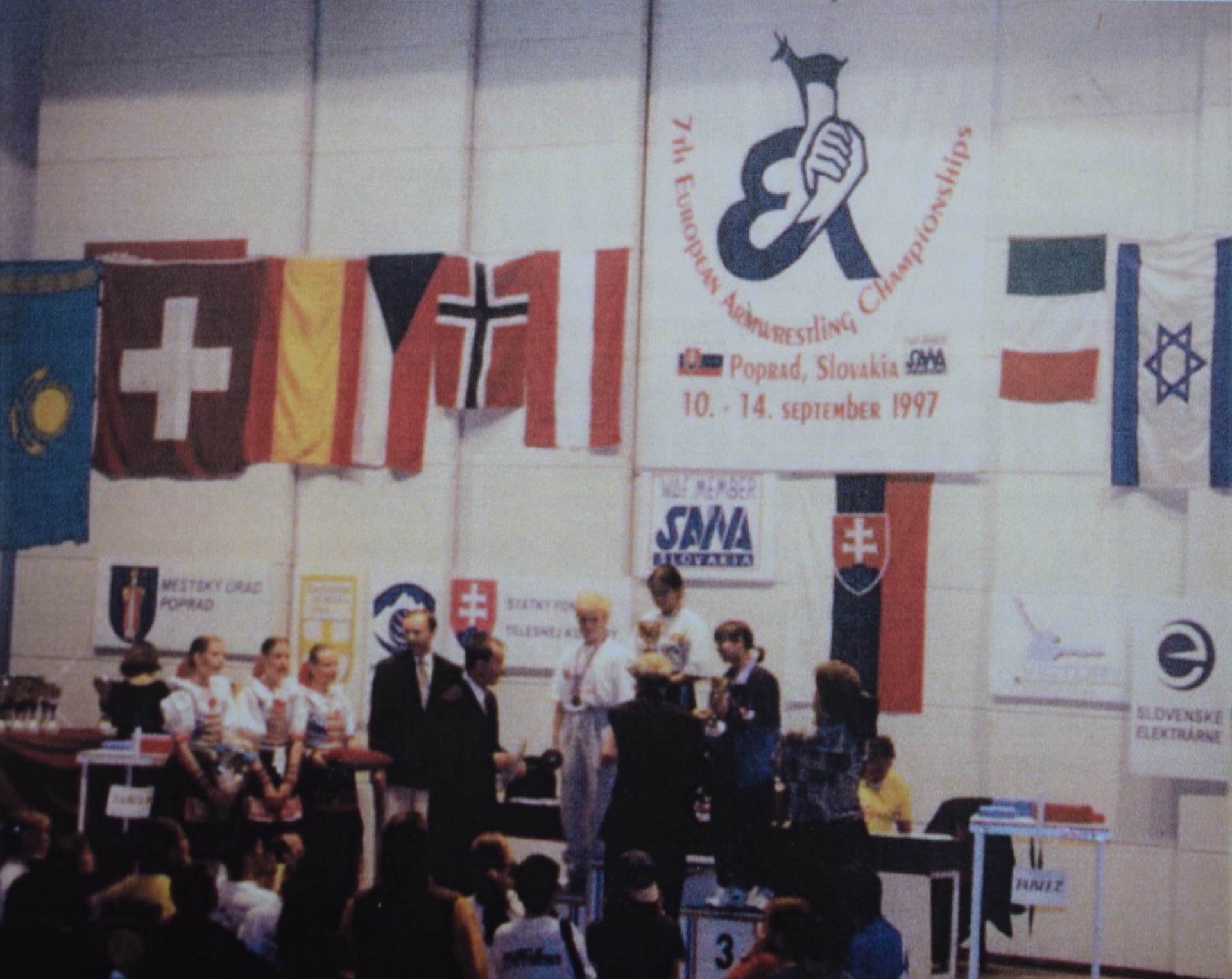
The decision to award the hosting of the 7th European Championships to Slovakia was made at the EAF Congress in 1995 in Moscow. From that moment, several months of work began for us. Choosing the right place, raising money, improving the organization of the event, ensuring a high-quality presentation of Slovakia, and preparing a quality team that would manage to win at least one medal. These were the goals we set for ourselves. We wanted to prepare a championship that would be a breakthrough, that would bring innovations, and that would bring the organization of armwrestling events closer to other sports. Many things that are now common and no longer seem exceptional happened for the first time right here in Poprad.
A very important moment was the assumption of patronage over the European Championships by Prime Minister V. Mečiar. This fact helped us open doors to many sponsors and thus secure the financial coverage of the event. An equally significant factor was the approval of the event date for September (EAF Congress 1996). For us, the date was crucial because in September, the sanctioned J. Germánus, in whom we placed our greatest medal hopes, could already compete.
At the EAF Congress in Taglio di Po, Italy (1996), we presented the venue of the championship (Poprad), the championship logo, and the program. It was the program with the exact schedule of the competitions that met with huge acclaim. Something like that had not existed until then. Simply, the competition started in the morning and ended whenever it ended. Competitors had to sit and wait for their turn for several grueling hours. We wanted to avoid this. We wanted everyone to be able to prepare as best as possible and spend only the minimum necessary time in the hall.
The choice of Poprad as the host city was conditioned by the excellent possibilities it provided us. Whether it was the sponsorship background, good contacts with the city management, or our effort to show the participants part of Slovakia's amazing nature. The only complication was transportation. In 1997, there were no low-cost airlines, flying was not so common and cheap. And besides, not many flights flew to Slovakia. However, the advantage of the European Championships was that many teams came by bus or car. And those who flew to Vienna or Košice, we transported to Poprad by train.
From the first moment, we wanted the European Championships to be the largest and highest quality. We contacted all European federations and visited foreign competitions. We spoke personally with many presidents, coaches, and athletes. We managed something unprecedented until then. 294 athletes from 23 countries came to Poprad. In today's times, these numbers seem small, but in 1997 it was a miracle (just a reminder that at that time there were no categories for juniors, grand masters, senior grand masters, or disabled).
At the championship, we introduced a whole range of organizational innovations. We placed great emphasis on registration. We didn't want teams to have to spend hours on it or for chaos to reign, which we succeeded in doing. Precisely assigned tasks for the registration team, a precisely determined order of teams, and everything went like Swiss clockwork.
Every morning before the competition, start lists were posted (for the first time in history), where team leaders could check the seeding of their representatives. For the first time, the first round of matches was clear and published in advance.
Every evening after the competition, results were distributed (for the first time in history). We established a press center (for the first time in history) for the media. We managed to ensure information about the championship through domestic TV stations and the news station WTN, which provided clips from the Poprad European Championships to 150 television companies from all over the world.
We "managed" the competition using Slovak brackets, which thus became the official competition management system in Europe until 2008. For the first time in history, we called competitors by name and not by number as was the custom until then. As the SAPR president said, "they are not prisoners to be called by numbers." Until then it was impossible, we made it happen.
Also, for the first time in history, we played national anthems for the winners.
Those of you who go to competitions know that today monitors are common where you can see who is competing with whom. That was not possible at that time; computing technology was not yet so accessible and, above all, cheap. We therefore invented a system of information boards where athletes and spectators could see how everyone was doing. It was indeed huge manual work, but it was met with great appreciation from athletes and officials. Suddenly, there were no anonymous athletes behind the tables. Of all of them, just one voice from the German athlete P. Spatz, which I remember to this day: "it was amazing, I had tears in my eyes when I heard my name."
We did it. We brought innovations that influenced the organization of European and world championships for many years. We organized a championship that its participants have not forgotten to this day.
We devoted two years of work to the preparation of the national team for the European Championships. We intensified work at training camps and included regular international trips in the program. We wanted it not to be just about one athlete in Poprad, but for us to compete with quality in as many categories as possible.
Slovakia was represented by 6 women, 13 men, and two men in the masters category. An unprecedented number of representatives. However, our team was not only large in number (the second largest delegation at the European Championships), but as a team, we took a fantastic third place in the nations' ranking. Only armwrestling powerhouses like Russia and Georgia remained ahead of us!
Among the women, we were represented by: A. Brettschneiderová, D. Múčková, M. Dusiková, Ľ. Janíková, E. Koczková, and M. Pastuchová.
In the men's categories, they were: R. Dobrovič, J. Durec, J. Gallik, P. Gazdarica, J. Germánus, I. Ivančo, P. Jarombek, P. Klúčik, M. Koczka, A. Lascsak, A. Narančík, J. Petras, J. Rerko.
Among the masters, J. Ďalák and V. Dobrovič.
Slovakia won five senior medals: J. Germánus (gold and silver), M. Pastuchová (silver and bronze), R. Dobrovič (bronze), and two in the masters categories: J. Ďalák (silver), V. Dobrovič (silver).
In addition, six unlucky fourth places: A. Brettschneiderová, Ľ. Janiková, M. Dusiková, P. Gazdarica, A. Narančík, and J. Rerko.
Of course, the medalists pleased us the most. J. Germánus gilded his return to the pulling tables. M. Pastuchová confirmed her place at the top, and for the very young R. Dobrovič, it was his first taste of medal positions.
P. Gazdarica was certainly the most disappointed, as he had what it took for a medal in Poprad, but even with the "help" of the referees, he did not reach it. The old gentlemen J. Ďalák and V. Dobrovič stepped up and both took second place in their categories.
The Poprad championship touched our hearts. We dedicated a piece of our lives to it. Despite the enormous exhaustion, we gave it everything. Whether we as officials or the athletes behind the tables.