10.04.2020
Lightning Start - 1993
The founders of SAPR faced a difficult task. To think about how to promote the new sport, how to organize competitions, and how to bring it to public awareness. Here, the vision of President Milan Čapla manifested for the first time. He knew what he wanted to achieve. To turn armwrestling into a sport. A sport like any other. And for that, it needs competitions. And a system that will motivate athletes to participate in them.
But the most important thing was to start. And it started grandly. Right in February, we organized the Grand Prix of Slovakia with international participation. In addition to our own, representatives from Czechia and the previously mentioned Mudžišvili from Georgia took their places at the tables in the Bratislava House of Sport. A total of 52 men eager to pull measured their strength with their right hands in 5 weight categories. I cannot fail to mention the memorable winners of the individual categories: up to 70 kg: Stanislav Hankoščák (Hlohovec), up to 80 kg: Alex Mudžišvili (GEO), up to 90 kg: Ján Germánus (Revúca), up to 100 kg: Anton Žák (Partizánske), over 100 kg: Jozef Durec (Hájske).
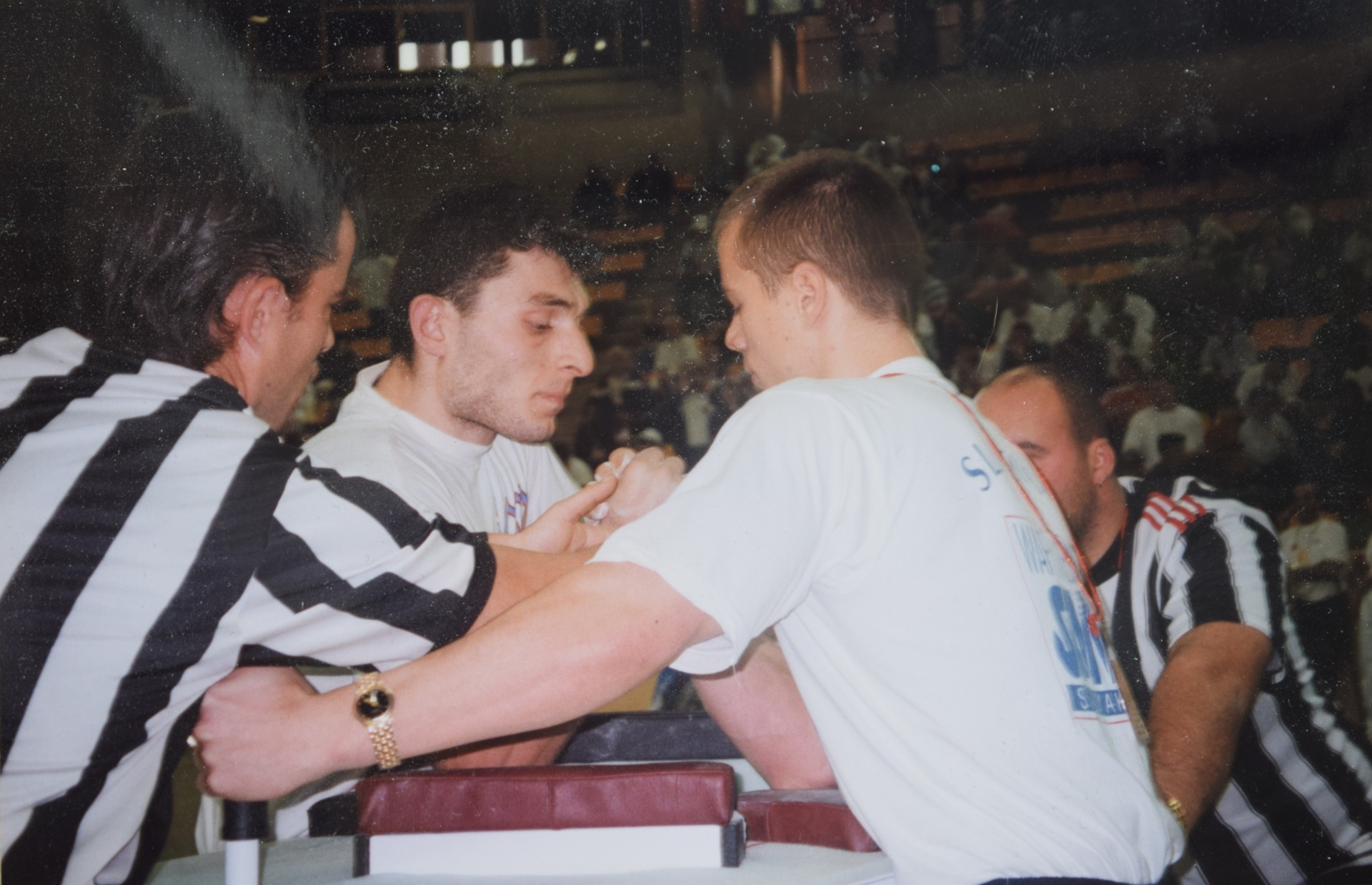
The Grand Prix of Slovakia ended in success, as evidenced by the filled hall of the House of Sport. But one swallow does not make a summer. The president's vision manifested immediately after the Bratislava competition. The idea to organize a long-term competition in the style of a league was brilliant. We called it the Slovak Cup. In the very first year, we organized four rounds - Pezinok, Senec (1st Senec Hand), Košice, and Martin. The top 8 in each category earned points for the continuous standings (now called the ranking) in individual categories. And the top eight in each category were nominated for the Slovak Championships (MSR) at the end of the year. Scoring and participation in the MSR were meant to be the greatest motivation for participating in competitions. The first steps, the first weeks of work, and immediately a shift of armwrestling into another galaxy. Nowhere in the world at that moment did they have a long-term competition. Nowhere in the world was there a ranking. Slovakia was first.
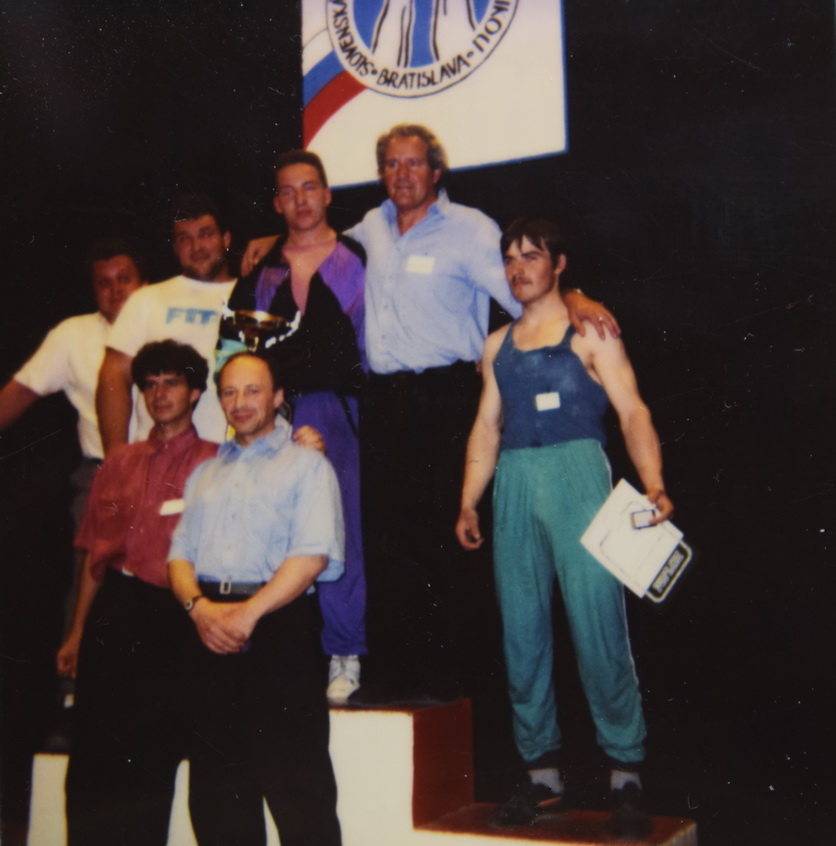
The first Slovak Championships took place on December 18, 1993, in Bratislava, and the first Slovak champions were: up to 70 kg: Štefan Vadovič (Doľany), up to 80 kg: Robert Škvarek (Bardejov), up to 90 kg: Ján Germánus (Revúca), up to 100 kg: Pavol Ochodnícky (Trenčín), over 100 kg: Jaromír Botlík (Myjava).
Another moment that was supposed to expand armwrestling across Slovakia and help create hubs for development and training was the founding of clubs. The first was the Senec club—how else, since the two most hardworking people in the movement came from Senec. It was only necessary to come up with a name. Something that would catch on. Something similar to FC, FK, ŠPK, HC, and the like. After various attempts, I named the Senec club Armwrestling klub Senec. Although the president didn't like that I was mixing English with Slovak, that was exactly what I liked. And after all, there are no limits to creativity. AWK caught on and still functions today. And not only in Slovakia but also in neighboring Czechia or in Balkan countries. After the first club, others followed. I will mention only the first ones - AWK Trnava, AWK Bánovce, AWK Pezinok....
In addition to the competitions themselves, a great deal of work was done on their organizational and technical support. For example, the brackets (double elimination trees) used in the world allowed for manipulation with the seeding of competitors even during the course of a category. I tried all the variants that came into my hands, and none of them appealed to me. I went through all the versions, combined the best of them, and added rules to prevent manipulation. Likewise, I didn't like the versions of brackets for every specific number of competitors. The bracket layout then allowed for a "bye" for a competitor throughout the entire course of the competition. Even before the match for advancement to the semifinals. This method favored some competitors and, above all, allowed the results officials to interfere with the management of the competition. It needed a universal solution. Simple, valid in all cases, and retrospectively verifiable at any time.
Therefore, I thought about it and proposed that all "byes" should be in the first round. From that moment on, the bracket was full. How did I achieve this? Simply. The brackets always had to be designed so that after the first round, the winner's bracket was completely filled with competitors. I achieved this by creating brackets for 2, 4, 8, 16, 32, and 64 competitors. I also changed the "shuffling" in the losers' bracket to fulfill the rule that the same two competitors must not meet during the competition earlier than in the battle for medals. Another thing I changed was the drawing and seeding. "Luck of the draw" until then meant that there was no traceable rule for how competitors should be seeded into the bracket. I therefore put into practice a simple method known from other sports. Starting numbers in a category were sorted by size, and seeding into the bracket was as follows: the highest number with the lowest, the second highest with the second lowest, etc.
The fact that the Slovak bracket system was successful on the international stage is evidenced by the fact that the European Championships from 1997 to 2008 and the World Championships from 1999 to 2001 were managed according to it. Even the current system in use drew inspiration from ours, the Slovak one.
At the end of the year, at the conference, a new executive committee was elected, which worked in the following composition: Milan Čapla, Marian Čapla, Ján Ďalák, Marek Krajči, Tibor Kvačkaj, Milan Kušnier, and Ľudovít Major.
The year 1994 awaited us, the year in which we stepped into world armwrestling....